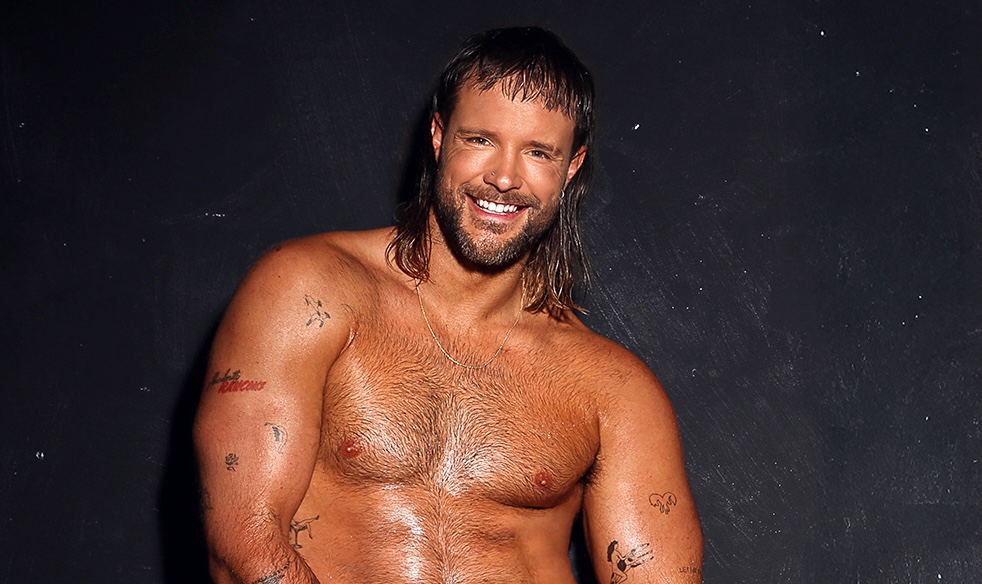
It was something from left of field – an AFL footballer who’s into men. Former West Coast Eagles Defender, Mitch Brown, announced in the media that he was bisexual, and collective jaws dropped in both the LGBT and sporting communities. It was followed by celebration, praise and even hate.
Photography by Christian Scott
In my exclusive interview for DNA Magazine, I found Mitch to be every bit as confident in his own skin as he was kicking goals in a stadium full of thousands.
From the outset, Mitch Brown has the appearance of the quintessential Aussie lad. Growing up in regional Victoria, he and his brothers’ recreational time was spent amidst farm life, basketball, rowing, and football. The latter took Mitch and his twin brother Nathan into the soaring heights of Australian Rules Football (AFL) where Mitch spent ten years playing for the West Coast Eagles.
During that time, the sportsman tackled opponents on the field, but off-field, he was tackling something more personal – he was a bisexual man in a sporting world, often defined by toxic masculinity. Like many, Mitch questioned his sexuality early in life, with an adolescence weighed down by uncertainty, confusion and guilt.
“I’ve always had this sense of curiosity,” says Mitch.
“I’ve never not been attracted to women, but I’ve never not been attracted to men. I went through the Catholic school system, so even as a boy, I had that religious element consistently telling me that marriage was between a man and a woman. When I was young, I’d have thoughts about being gay, and I’d feel a bit weird thinking that a guy was hot, but I’d think it was just a weird mind thing and make excuses for it. Every time the gay question would come up in my mind, I’d think maybe I am, but I didn’t feel I could talk to anyone about it. But I could at least explore it.”
“I’d have thoughts about being gay, and I’d feel a bit weird thinking that a guy was hot.”
“If someone were to ask me, ‘How do you know when you’re gay?’ I couldn’t answer it openly,” says Mitch.
“I wanted to learn more, but my only education about it at that age was that you’re either gay or straight, there’s no in between or fluidity. Because I had these feelings, I thought maybe I was gay, but I also had those feelings toward women. So, there was a sense of confusion, and I’d think, let’s park that and play on with life for a bit. Don’t dare explore that!”
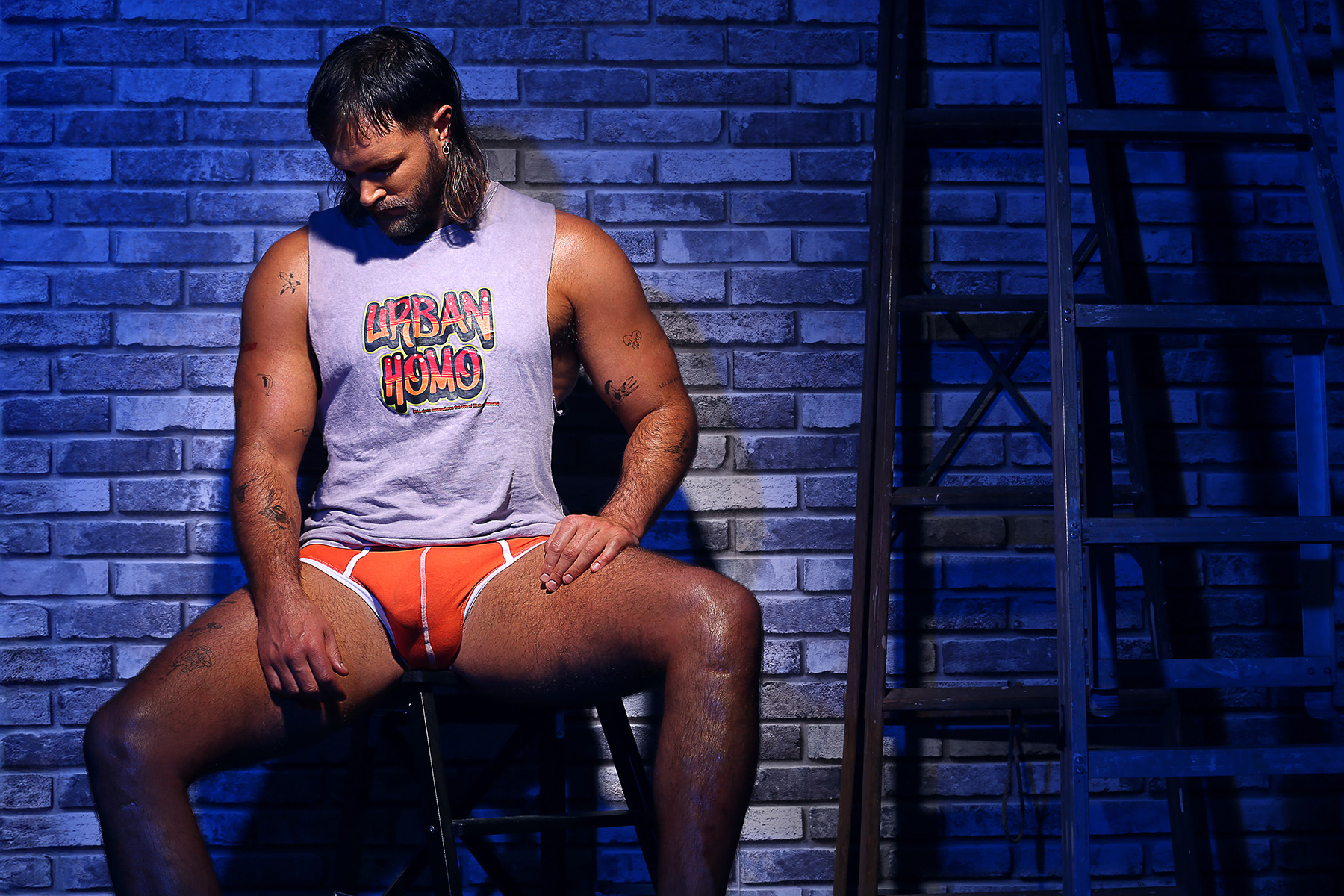
Mitch Brown Photography by Christian Scott
“I didn’t know where, how or who to turn to,” says Mitch.
“If you look at the movies we grew up with in the Nineties and early 2000s, gay people were the punchline for many jokes. That was a normalised thing throughout my school years, and it was consistent in most schools. Even today, the word gay is used as a belittling term with the whole, “That’s so gay”. I would constantly hear that.”
For Mitch, coming out opened a brand-new world. He’s discovered both the pros and cons of being in a marginalised community, especially after many years in a world where he felt ‘privileged’.
“When I was closeted, I lived in a very privileged world”.
“I’m a tall, white footballer who never had insight into what people consider a minority group. In the last six weeks alone, I’ve gained a lot of insight, and despite my looks and build, I’m still fearful. While riding a tram, I’ll look to the side thinking, “Who’s looking at me? Are they a homophobe?” Is it a hyper-masculine man who thinks I’m filth?” It’s not a nice feeling, and this is in Australia, so imagine what it’s like in other countries, especially where they have jail terms and death penalties. It’s just fucked.”
I’d fool around with men with what we’d call the ‘disco pash’. We treated it as a joke, but afterwards, I’d think how much I enjoyed it.”
For Mitch, exploring his sexuality was something of a slow burn – something not uncommon amongst queer men exposed to a world of sports, pubs and masculine peer groups.
“I used to hook up with mates,” says Mitch.
“Throughout my twenties, I’d fool around with men with what we’d call the ‘disco pash’. We’d think we were just being wild and having a bit of fun. We treated it as a joke and didn’t think we were gay, but afterwards, I’d think about how much I enjoyed it. There was passion, emotion, and it was kind of liberating. I was curious to explore that, but fear would override it. Internalised homophobia would kick in, and I’d tell myself it felt ‘yuck’. It was a battle there for a while, and it was not until leaving football that I felt safe enough to explore my sexuality and talk openly about it. To have real, intimate relationships with men, feeling comfortable and proud. My partner, Lou, has been amazing through all of this. We’re both bisexual and can help each other explore our feelings, and not feel ashamed to talk about our attractions towards someone else.”
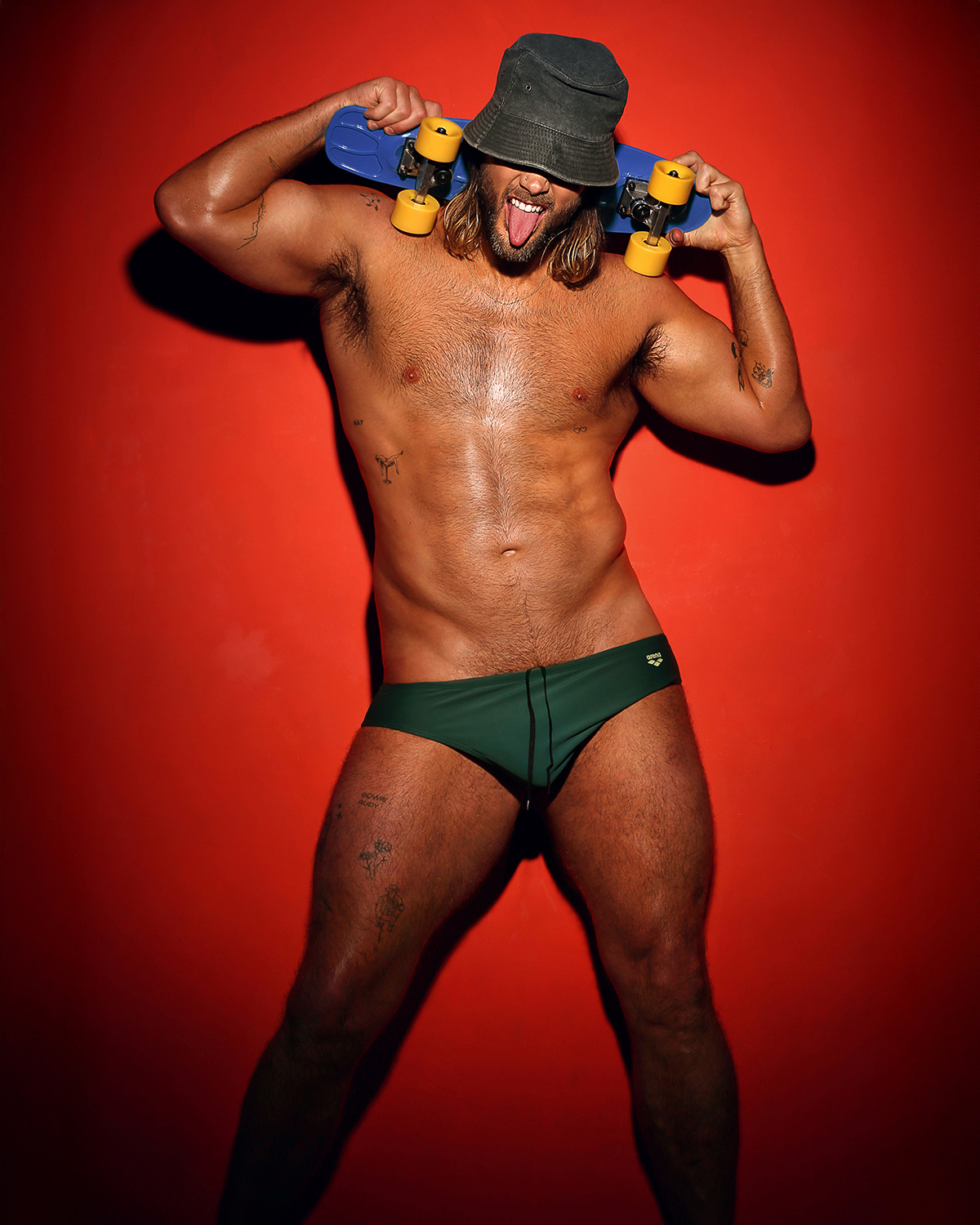
Mitch Brown Photography by Christian Scott
But if coming out to the public isn’t enough, there are critics from many angles, including bisexual erasure – the idea that being bi is just a cover for being gay or even straight. Patsy Stone famously said that bisexuality was just people being greedy. But that, of course, was comedy.
“I know the term bi-erasure, and some people do label me as just gay,” says Mitch.
“But because I’ve identified myself publicly, others who identify as bisexual have reached out to me. I feel seen, and they feel seen. Even in my current straight relationship with Lou, people attack the situation and also her, by saying things like, “You know he’s gay? He just doesn’t know it yet”, or “He’ll be sleeping with men behind your back”. Some people don’t get that someone can have a monogamous relationship and still be bisexual. It is possible to be attracted to more than just one gender.”
“I was already out to friends and family, so I didn’t need to do it, but there was a bigger point to make.”
Mitch’s partner, Lou Keck, has been a constant source of support in his coming out, helping to navigate obstacles such as online trolls and questions about their relationship. But if anything, it’s cemented their relationship.
“Even though bisexuality is so common within the LGBTQIA+ community, I think it’s still so misunderstood,” says Keck.
“It can be difficult sometimes to find a place where you belong. You often feel too straight for queer spaces and too queer for straight spaces. I think that leads to hiding parts of yourself depending on your environment, which is something both Mitch and I can relate to. We’ve both had the privilege of being perceived as straight for most of our lives, which can make things easier in a lot of ways, but it also adds to the feeling that you don’t belong.”
“I’ve known about Mitch’s sexuality in some way or another since before we got together, so there’s never been any big reveal for me. It’s always been this amazing part of him that we’ve been able to explore together. Witnessing the impact his story has had on so many people has been incredible. I’m so proud of Mitch and more in love with him than ever!”

Mitch Brown Photography by Christian Scott
Bi-erasure was an issue both Lou and Mitch were expecting. Questions over their sexuality and commitment became part of the online dialogue and trolling that followed Mitch’s initial announcement.
“The questioning from people online is easy to dismiss, as it can be ridiculous,” says Keck.
“People ask Mitch to prove his sexuality or accuse him of lying both ways. Some say he needs to admit he’s really gay, and others that his bisexuality doesn’t count because he has a girlfriend. But being comfortable with my own fluid sexuality has made it very easy to understand and support Mitch with his.”
But the story escalated when Geelong AFL footballers Bailey Smith and Patrick Dangerfield took to social media during the antics of ‘Mad Monday’ – an Australian tradition where sportsmen party hard and dress in costume, sometimes causing controversy. Smith posted an image referencing Brokeback Mountain, quoting, “This is what losing a granny (Grand Final) does to ya.” Mitch, unimpressed, called it out, asking for them to do better.
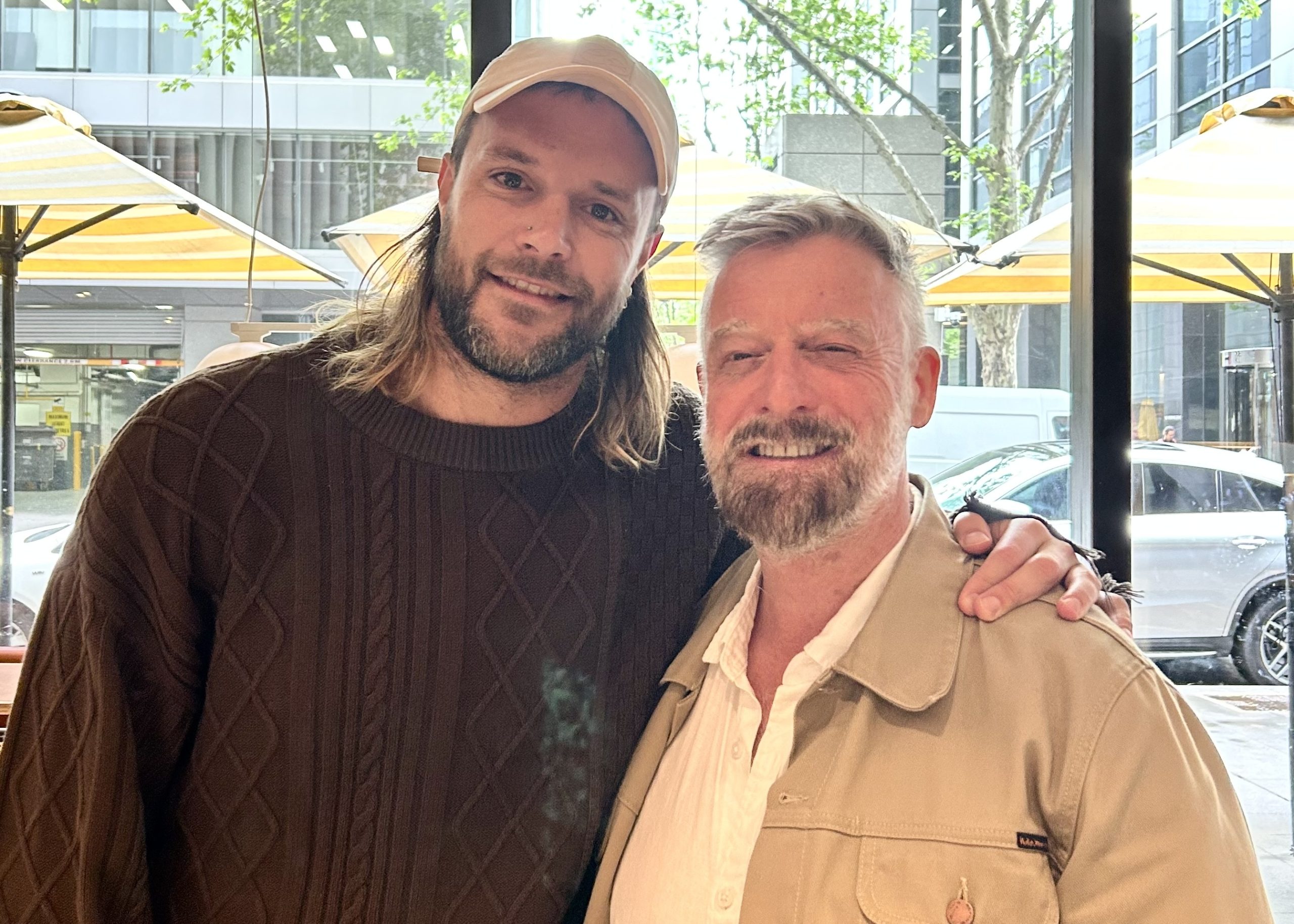
Matt with Mitch Brown
“There was that one week where the hate dialled up again with the Mad Monday stuff,” says Mitch.
“Lou and I decided we had to address it publicly because people love to say, “This is so positive, Mitch. We’ve come so far!” But people don’t like to hear that maybe we haven’t come as far as we thought, and there’s still a lot of shit out there. I genuinely believe we’ve come a long way in the AFL, including in addressing racism, but there’s still plenty to be done. That’s one of my reasons for coming out. Although I’ve benefited in terms of my own connection to identity, relationships and self-confidence, this is all very much about others feeling safe in themselves. That’s the bigger message. I was already out to friends and family, so I didn’t need to do it, but there was a bigger point to make.”
“I’ve been to the Pride March with my son on my shoulders.”
In October, Mitch and Lou were invited back to Perth for the West Coast Eagles’ AFL Pride Round, where Mitch addressed the AFL women’s team (AFLW) to a rousing reception. Many of these players identify as queer.
“It was so bloody amazing,” beams Mitch.
“I got invited to speak to the players, and just being among those festivities was such a wonderful time. It was a fun week of queer joy. We have so many people to look up to in the AFLW competition. Every AFL club has a women’s team, and most have queer players. As female players alone, the word is trailblazer. It’s all about making change and pushing through barriers, which might be tough for that player who comes out, but one day there will be a group of LGBT players, and it will then be so much easier for everyone else. That’s trailblazing!”
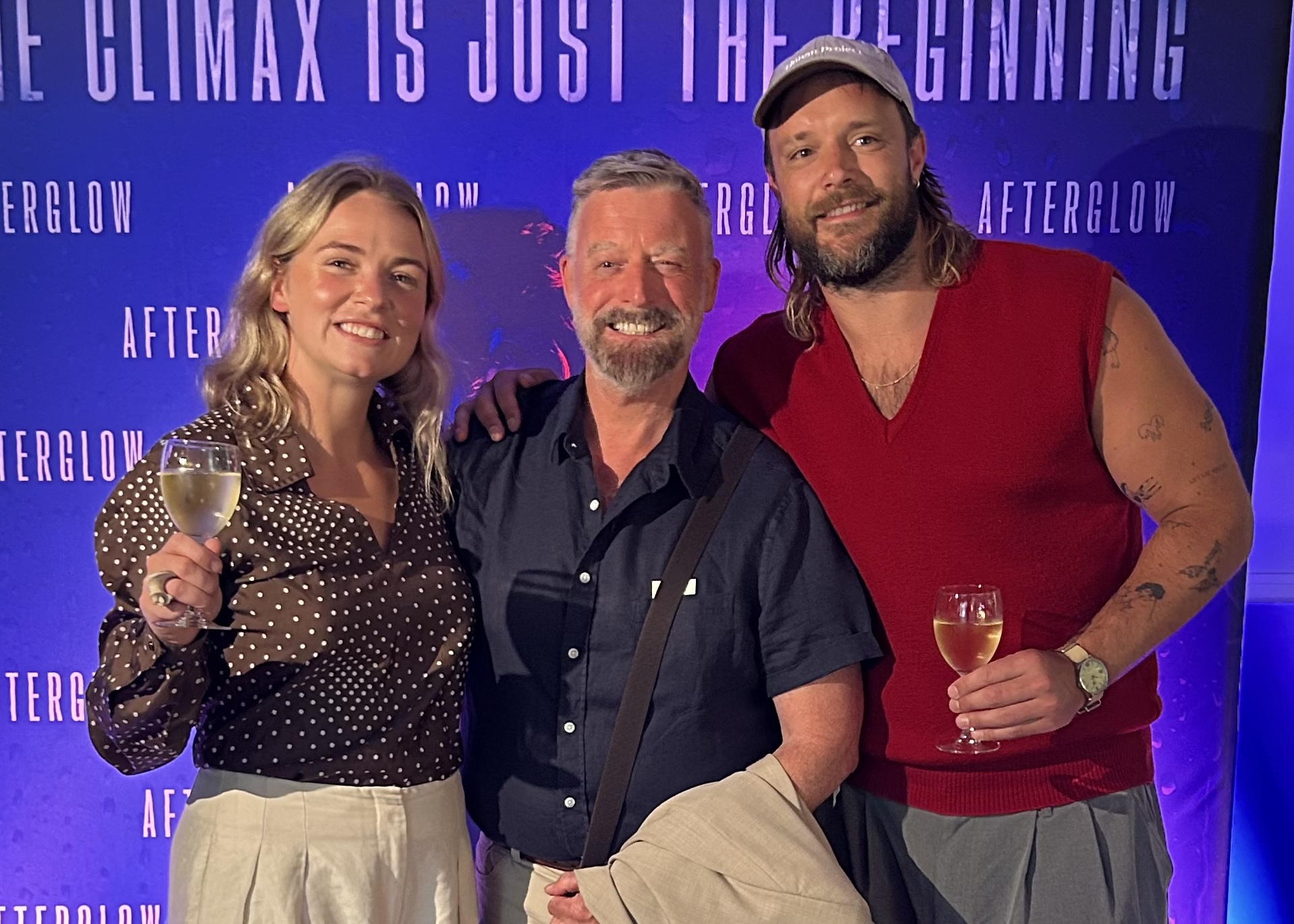
Matt with Mitch Brown and his partner Lou Keck
But what about the male footballers? Mitch’s former teammates, opponents and others involved in the sporting codes.
“The male players have been considerably fewer,” says Mitch.
“But some, like Tom Campbell (Melbourne Demons) and my former teammates Sharrod Wellingham and Ben Brown, have reached out and been prepared to speak up. I don’t know the reason why others haven’t, and I’d hate to think it’s a fear of being associated with queerness, but I have heard from some with a sense of apology. They’re aware that they may have contributed to an overall unsafe space for a queer person or others. There’s no need for an apology, and they don’t owe me anything, but the fact that they feel that way is a very nice thing.”
One particularly touching moment for Mitch was being invited to speak on The Footy with Marns podcast, run by Marnie Vinall and Hester Brown (wife of Ben).
“It was an awesome moment when Ben and I went on the podcast. Lou was there too, and Ben surprised me by reading ten or so messages of support from current male and female players. It was bloody fantastic! Ben’s been standing up and advocating for a long time about men’s behaviour and safe, inclusive spaces.”
But there have been others from various sporting codes who have reached out with support, most notably those who have travelled the same path.
“Josh Cavallo (soccer), Isaac Humphries (NBL), Jason Ball (VFL), and Ian Roberts (NRL) have all sent messages of support, as did R.K. Russell (Dallas Cowboys), the first player to come out as bisexual in the American NFL. They all said, “I’m here if you need anything”. I mean…there’s that wonderful sense that I’m not alone. I feel we’re part of a group that has each other’s backs.”
Ian Roberts, a pioneer for the LGBT sporting community, famously came out in 1995 while still playing rugby in the Australian NRL.
“It’s wonderful that Mitch has found that peace,” says Roberts.
“I call it peace rather than courage because peace is something you’re comfortable with. For people who feel unsafe in that world, they are not lacking courage. But I do feel for people who come out after they’ve retired because they never got to experience it with their teammates. I’m glad I came out before I retired because it was wonderful to have that supportive camaraderie around my sexuality. Mitch came out after he retired because he didn’t feel safe enough to come out while playing, and that’s not a criticism of him. I understand why men wouldn’t want to come out even now. Josh Cavallo and Isaac Humphries are the only two Australians in contact sports who’ve come out while still playing, since I came out thirty years ago.”
Interestingly, in the decades that have followed Roberts’ landmark coming out, he feels there is still a huge amount of work needed to educate against homophobia – a passion he advocates through his work at Qtopia – Sydney’s centre for queer history and culture.
“Mitch’s coming out isn’t a declaration that the game is slowly becoming more accepting,” he says.
“There are still huge issues, and that’s why I always say education is key. Education at the grassroots level. That’s our greatest sword and shield. Homophobia hasn’t changed in a thousand years, and within the confines of the locker room and in that world, it’s still seen as a weakness or as being less. There may be many more allies within the sport speaking up, but it’s still not a safe environment. You can’t tell me there aren’t any current gay AFL, rugby or rugby union players. But they don’t come out because it’s not a safe environment. I imagine there’s roughly ten per cent of the playing staff dealing with that. They say about ten per cent of the population is gay. The flipside of the coin is that if you’re in a high-profile sport, once you come out, there’s no going back in. The blinkers are now off, and Mitch’s life will enter a whole new experience. I get reminded all the time that I’m gay, but I always say that being gay is my superpower. I love being gay. It’s the best thing ever, and given a choice, I’d be gay every time!”
So, what’s holding back those ten per cent of players from coming out, and, as Roberts explains, finding their peace? ABC sports broadcaster Corbin Middlemas believes several factors are at play.
“We’ve never had an active player come out as gay, so the first would understandably be a big deal,” says Middlemas.
“And the added attention wouldn’t be for everyone, as the media focus would be intense. That doesn’t always mean it will always be critical, as progressive outlets will often want to do their own positive press. But it leads to a very different experience for that athlete, compared to their peers. In any team sport, athletes are reluctant to do anything, shifting the focus from the team to the individual. Also, many AFL careers are over by the age of twenty-two, and then there’s the fans. Everybody has access to social media, and unfortunately, there are considerable emotional risks to coming out publicly. It’s a lot for young guys to get their heads around while in a professional sporting system.”
Middlemas, who publicly came out as gay in 2018, believes that while the AFL does well to advocate various courses, it could do more in promoting positive LGBT awareness.
“Clean up the language on-field and in the locker room,” says Middlemas.
“We’ve seen six incidents of on-field homophobic slurs across the past two seasons, which the league has begun penalising with suspensions. This rests entirely with the players. No other workplace in Australia in 2025 would tolerate it. The other thing the AFL can do is educate its fans and participants as to why LGBT issues are important. The league advocates health causes extremely well, such as raising awareness for breast cancer, motor neuron disease, and others. Queer kids are five times as likely to contemplate suicide compared to their straight friends. Positioning the topic for what it is – a health crisis – can break down some of the stigma and create understanding. I feel chuffed for Mitch that he’s comfortable sharing his story. It provides parents with a talking point for their kids, and vice versa. It gives LGBT kids a chance to see themselves in an industry where they haven’t until now.”
For Mitch, it extends beyond rules, education and awareness.
“For me, it comes down to trust,” he says.
“I hear the support, but when push comes to shove, will it help a player coming out? We hear things like, “The AFL will wrap their arms around you”, but I wouldn’t trust it would happen, because we have no real precedent. There’s no case study, and instead, there’s fear. I have no doubt that I’ve helped open some doors and conversations, but I’m now a past player. I don’t have to run out into the arena as a gay or bi person. I love the word ‘trust’ because it can be made, built and strengthened. If a player came out and the team, coach, and club listened, learned, and began to build trust – a process that would need to be two-way– it would create an amazing environment for that player. “
One only needs to look at Mitch’s DNA photoshoot to see the intimacy and self-assurance he exudes – naked and clutching his iconic Aussie football.
“Both Lou and I suggested that pose,” Laughs Mitch.
“It was like, here’s everything! This is me and my football – armed and open.
The shoot was incredibly fun and a culmination of the self-confidence I’d developed. Being in front of the camera, naked and vulnerable! I was so proud of myself and confident in who I am. It was a milestone moment, reflecting on how far I’d come.”
There’s no doubt that Mitch has found the peace that Ian Roberts spoke about, and while he has a multitude of positive supporters, there’s no greater cheer squad than his partner, ex-wife, and two young boys.
“Lou, my ex-wife Shae and I have always put the boys first. That’s been our guiding light. Even if we have some debates or communication challenges, it’s about what’s best for the boys and that they’re happy and loved. Open and honest communication is not rocket science! Shae has been incredibly supportive in our co-parenting situation, and I couldn’t connect to my identity without Lou. It’s been ‘our’ journey, and I’m grateful for it. My boys are a catalyst, too. They love going to Midsumma, and I’ve been to the Pride March with my son on my shoulders. I want them to feel like they can be themselves and to allow their mates to be themselves too. I want that embedded in them as a genuine thing.”
At the age of 36, Mitch has achieved many milestones. Footballer, partner, husband, dad and advocate. But he’s far too modest to add one title he’s used to describe others – trailblazer. As he pointed out, it’s about standing up to make a change and pushing through the barriers. Mitch Brown is a trailblazer!
Follow Mitch on Instagram @mitchbrownie